The Construction Industry Scheme (CIS) changed on 6 April 2026. The deduction rates didn't move, but HMRC gained much sharper powers over gross payment status, and the cost of a careless supply chain went up. If you rely on being paid gross, this matters to your cash flow.
This is a plain-English summary for subcontractors. It isn't tax advice: talk to your accountant about your own position.
What is CIS, in one paragraph?
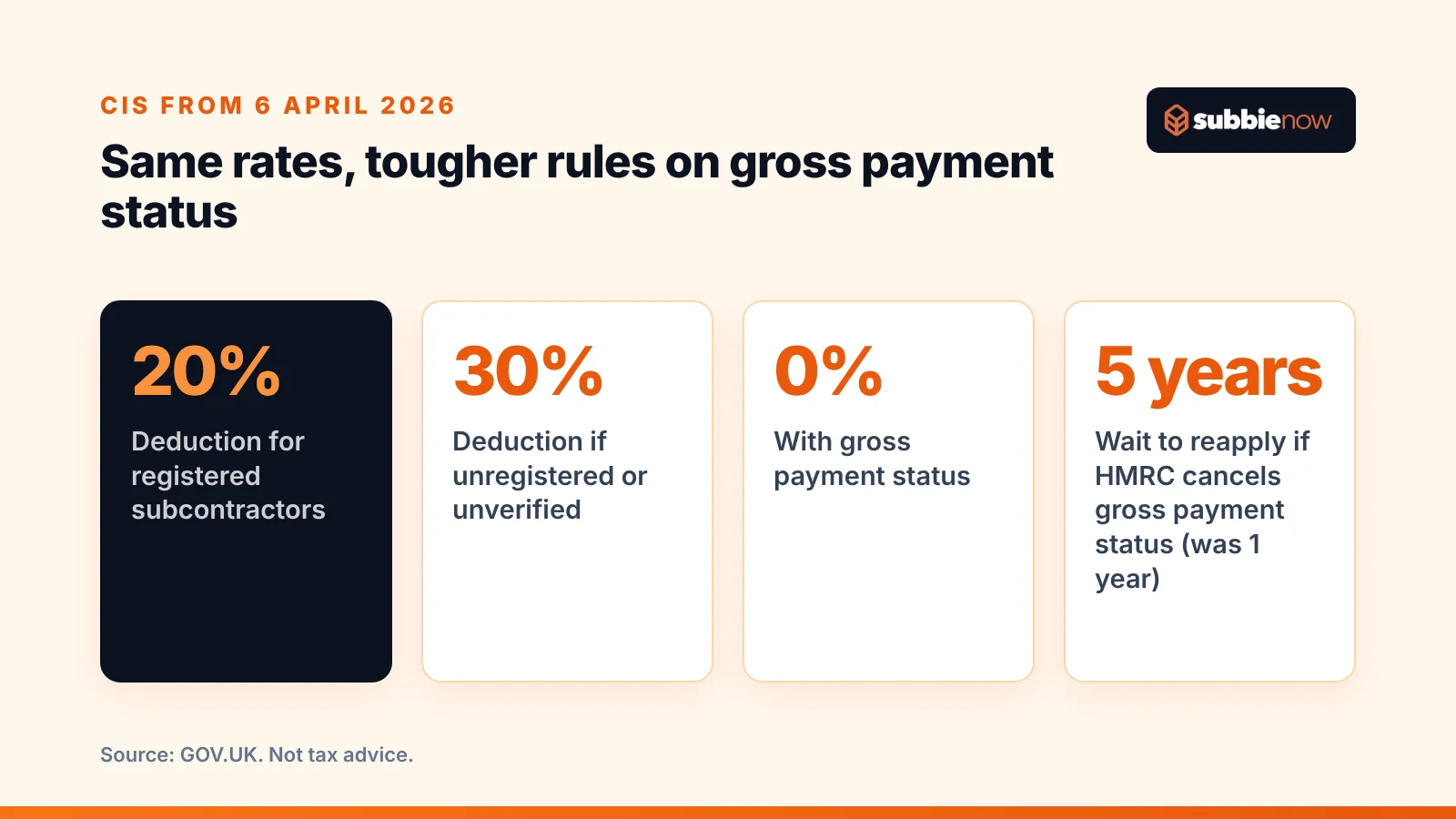
Under CIS, contractors deduct tax from the labour part of payments to subcontractors and pass it to HMRC as an advance against the subcontractor's tax and National Insurance. HMRC's published rates are 20% for registered subcontractors, 30% for those who aren't registered or can't be verified, and nothing for subcontractors with gross payment status.
What changed on 6 April 2026?
| Change | Before April 2026 | From 6 April 2026 |
|---|---|---|
| Cancelling gross payment status for fraud | Through the normal compliance review route | Immediate cancellation where HMRC shows the business knew or should have known a transaction was connected to fraudulent evasion of tax |
| Waiting period to reapply for gross payment status | 1 year | 5 years |
| Liability for lost tax | Mainly the fraudulent party | The business that knew or should have known can be made liable, with penalties of up to 30% |
| Nil returns for mainstream contractors | Not required | Required for months with no subcontractor payments, unless HMRC is told in advance |
The key phrase is "knew or should have known". HMRC doesn't have to prove you were part of a fraud; it has to show the warning signs were there.
Why does this matter to subbies?
Most subcontractors are both paid under CIS and, when they use labour-only gangs or smaller firms, contractors under CIS themselves. That puts you on both sides of the new rules:
- As a subcontractor, losing gross payment status means 20% coming off every labour payment for five years. For a firm running on thin margins, that's a serious cash-flow hit.
- As a contractor to your own labour, you're expected to check who you pay. Engaging people at rates well below market, not verifying CIS status, or ignoring subcontractors who disappear after being paid are the kinds of red flags commentators have pointed to.
How do you protect gross payment status?
- Verify every subcontractor before you pay them, every time a new one joins, and keep the verification reference.
- Keep records that show who did the work. Name, plot, date and what was done. If HMRC asks who was on site, you want the answer in minutes, not days.
- Watch for warning signs: rates that look too good, invoices from businesses you've never met, labour that changes company name every few months.
- Stay on top of your own compliance: tax returns, payments and, since 2024, VAT compliance all feed into the gross payment status tests.
- Write down your checks. A documented process is your best evidence that you didn't "know or should have known".
A worked example
Fictional example. Brook Plastering runs four gangs. Two are their own operatives; two are labour-only teams paid under CIS. Before April they kept gang names in a spreadsheet and paid on a weekly total.
Now, each operative is set up as a user with their qualifications, and every work submission records who did which plot, on which date, at which rate. When their accountant asked for evidence of who carried out work on a site in May, the answer came from a filtered report instead of a week of phone calls.
Where SubbieNow fits
SubbieNow isn't a payroll or CIS filing system: you still verify subcontractors and file returns through HMRC or your accounting software. What it does is keep the operational record that CIS compliance leans on: who each operative is, their qualifications, which sites they're assigned to and what work they submitted, plot by plot, with approvals and payment-split logic for shared work.
Sources
- GOV.UK: What you must do as a CIS contractor: make deductions and pay subcontractors
- GOV.UK policy paper: Tackling Construction Industry Scheme fraud
Want to see how SubbieNow records who did what, on which plot? Book a 30-minute demo.
Frequently asked questions
Have CIS deduction rates changed in 2026?
No. The rates are still 20% for registered subcontractors, 30% for unregistered subcontractors and no deduction for those with gross payment status.
Can HMRC remove gross payment status without warning?
From 6 April 2026, yes, where it can show the business knew or should have known a transaction was connected to fraudulent evasion of tax. The business cannot reapply for five years.
Do contractors have to file nil CIS returns again?
From 6 April 2026, mainstream contractors must file a nil return for a month when they paid no subcontractors, unless they have told HMRC in advance that they won't be paying any.