Retentions have been a sore point for UK subcontractors for decades: money for work that's been done, held back for a year or more, sometimes never paid. In 2026 the Government decided to ban them. This is where things stand and what it means in practice. It isn't legal advice.
What is a retention?
A retention is a percentage of each payment, commonly 3 to 5%, held back as security against defects. Typically half is released at practical completion and the rest at the end of the defects period, often 12 months later. Contractors hold retention against subcontractors in the same way clients hold it against contractors.
What has the Government done?
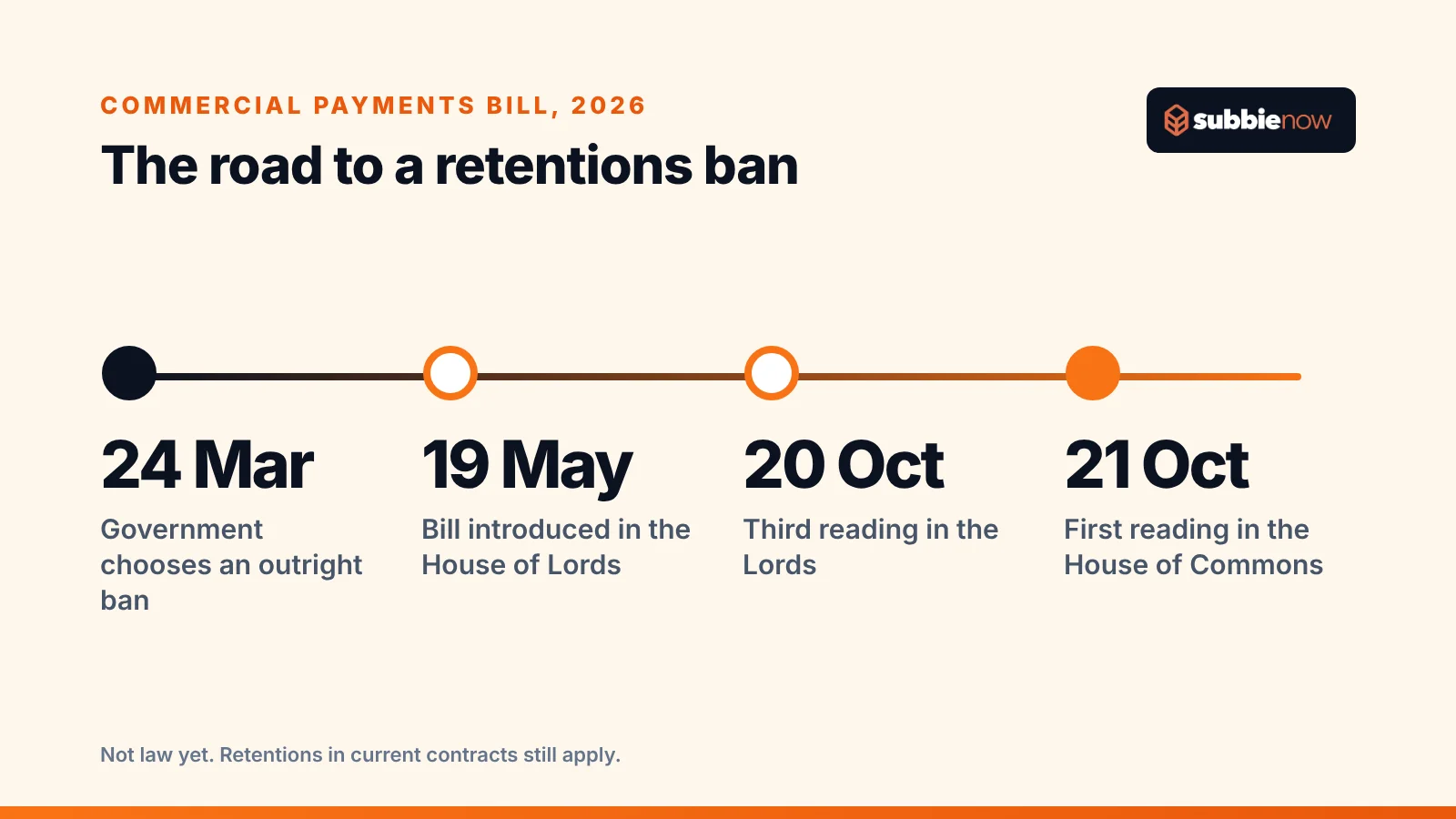
| Date | Step |
|---|---|
| 24 March 2026 | Consultation response published, choosing an outright ban on retentions in construction contracts |
| 19 May 2026 | Commercial Payments Bill introduced in the House of Lords |
| 15 September 2026 | Report stage in the Lords completed |
| 20 October 2026 | Third reading in the House of Lords |
| 21 October 2026 | First reading in the House of Commons |
The Bill would insert new provisions into the Housing Grants, Construction and Regeneration Act 1996 prohibiting the deduction or withholding of retention payments. It also covers wider late-payment reforms and stronger powers for the Small Business Commissioner.
When would the ban start?
Not immediately. Legal commentators have noted that the retention provisions are not among those due to start on Royal Assent, and some expect a lead-in period after commencement. The Small Business Commissioner has been reported as hoping for Royal Assent in early 2027. Watch for the final timetable.
What should subcontractors do now?
- Keep claiming retentions you're owed. Nothing changes for existing contracts yet.
- Track release dates: practical completion and the end of each defects period, per contract. Most retention is lost because nobody asks for it.
- Read new subcontracts carefully. Expect contractors to look for other forms of security, such as bonds, longer defects obligations or staged final payments.
- Price for the change. If retention goes, so might some of the leverage contractors use; if it's replaced by tougher defects terms, aftercare costs matter more.
- Get your defects records in order. Without retention, evidence of who caused a defect becomes even more important.
A worked example
Fictional example. A roofing subcontractor has £38,000 of retention held across six completed sites. Listing practical completion dates and defects periods shows £14,500 is already due for release. Each contractor gets a written request with the dates and the contract reference. The same list becomes a calendar of future release dates, so the next tranche is chased on time rather than discovered at year-end.
Where SubbieNow fits
SubbieNow builds sales applications from plot records, so values to date and deductions are visible per site, and its customer care module keeps the aftercare history that defects arguments turn on. Read more on applications for payment and Construction Act payment notices.
Sources
- UK Parliament: [Commercial Payments Bill [HL]](https://bills.parliament.uk/bills/4128)
- House of Lords Library: [Commercial Payments Bill [HL]: HL Bill 4 of 2026–27](https://lordslibrary.parliament.uk/research-briefings/lln-2026-0028/)
Book a demo to see how SubbieNow keeps applications and aftercare records together.
Frequently asked questions
Are construction retentions banned now?
No. As at late October 2026 the Commercial Payments Bill is still going through Parliament. Until it becomes law and the ban is brought into force, retention clauses in existing and new contracts still apply.
Will the ban apply to retentions on contracts signed before it starts?
That depends on the final wording and commencement rules. Keep tracking and claiming retentions on current contracts as normal.
What might replace retentions?
Commentators have pointed to alternatives such as retention bonds, stage payments with a final stage after defects are put right, and stronger defects obligations. Expect contract terms to change.