The VAT domestic reverse charge for building and construction services changed how VAT moves through the supply chain, and caused plenty of confusion for subcontractors who work on a mix of new-build and other jobs. This guide covers when it applies and, just as important, when it doesn't. It isn't tax advice: check HMRC's guidance and speak to your accountant.
What is the domestic reverse charge?
From 1 March 2021, for most standard and reduced-rate building and construction services reported under CIS, the customer, not the supplier, accounts for the VAT to HMRC. The subcontractor's invoice states that the reverse charge applies, and the contractor accounts for the VAT on its own return.
Does it apply to new-build housing?
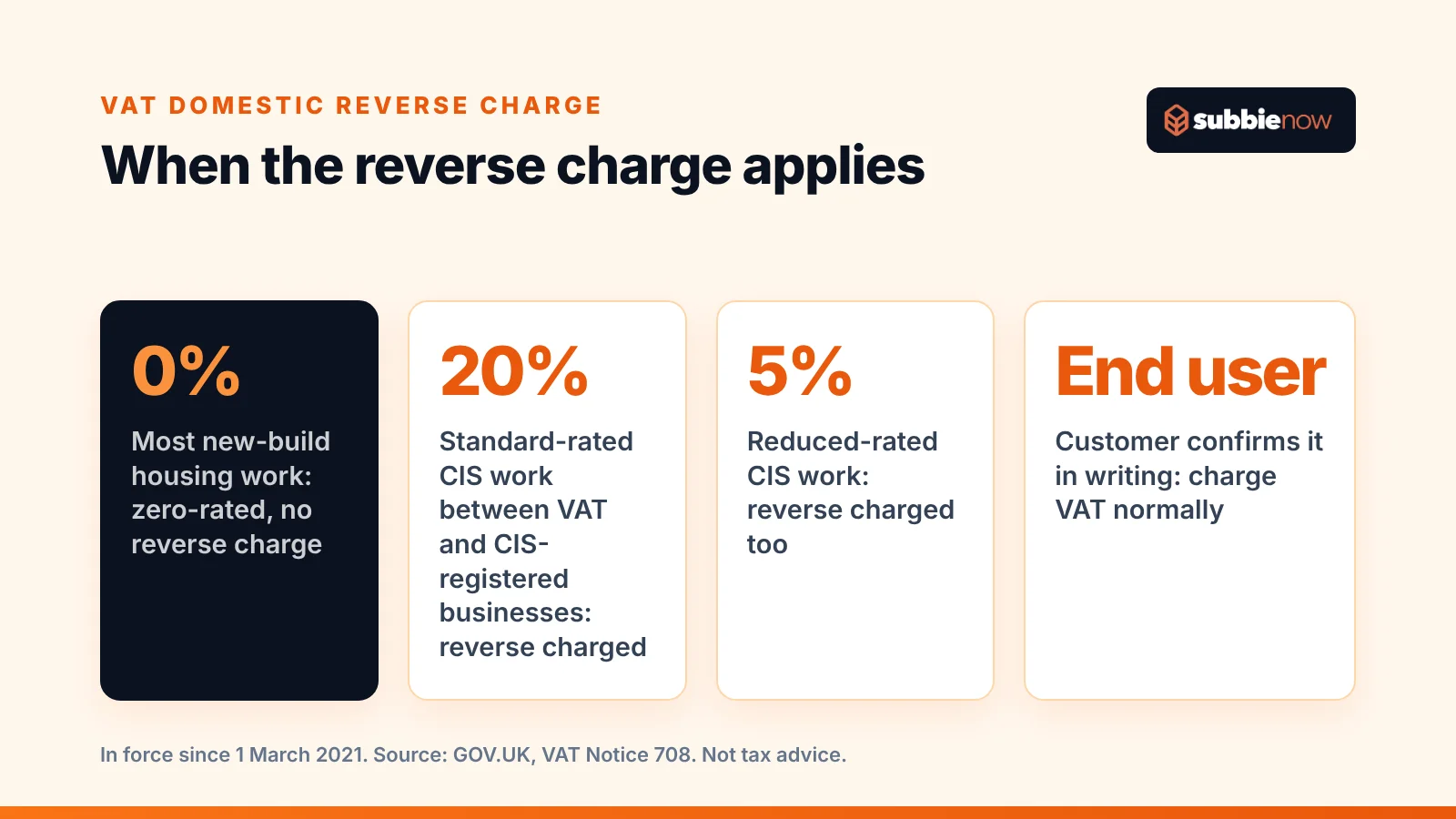
Usually not. Under VAT Notice 708, construction services supplied in the course of constructing new qualifying dwellings are normally zero-rated, including when supplied by a subcontractor. HMRC's reverse charge manual is clear that zero-rated supplies are excluded from the reverse charge because there's no VAT to account for.
So for many subcontractors working for housebuilders, the bulk of their plot work is zero-rated and the reverse charge doesn't come into it. Where it bites is the other work: commercial jobs, repairs and refurbishments, and reduced-rate work such as some residential conversions.
When does the reverse charge apply?
| Condition | Needed for the reverse charge? |
|---|---|
| The service is reported under CIS | Yes |
| The supply is standard-rated (20%) or reduced-rated (5%) | Yes; zero-rated supplies are excluded |
| You and your customer are both VAT registered | Yes |
| Your customer is CIS registered | Yes |
| Your customer has confirmed it's an end user or intermediary supplier | No: charge VAT normally |
| You're supplying materials only | No: charge VAT normally |
HMRC's guidance also includes a 5% disregard: if the reverse-charge element of a mixed supply is 5% or less of its value, the whole supply can be treated normally.
What goes on a reverse-charge invoice?
Alongside the usual VAT invoice details, show clearly that the domestic reverse charge applies (for example "Reverse charge: customer to account for VAT to HMRC") and the VAT rate and amount the customer must account for. HMRC's guidance gives suggested wording.
How does it affect cash flow?
On reverse-charged work, VAT no longer arrives with your payment, so you lose the short-term cash it used to provide. Subcontractors with a lot of reverse-charged work can find themselves in regular VAT repayment positions and may benefit from monthly returns. Your accountant can advise.
A worked example
Fictional example. An electrical subcontractor works on two jobs in October:
| Job | VAT treatment | What the invoice shows |
|---|---|---|
| 30 plots on a new-build housing site for a housebuilder | Zero-rated construction of new dwellings | £0 VAT; no reverse charge wording needed |
| Rewiring an office refurbishment for a VAT and CIS-registered main contractor (not an end user) | Standard-rated, reverse charged | Net value, the 20% VAT the customer must account for, and reverse charge wording |
Both are reported under CIS, and the contractor deducts CIS from the labour elements as normal.
Where SubbieNow fits
SubbieNow handles the operational side: applications built from plot records, VAT codes set up in the system, and the documents the contractor needs. Your accounting software and accountant handle the VAT return. See also CIS changes from April 2026.
Sources
- GOV.UK: VAT domestic reverse charge for building and construction services
- GOV.UK: Buildings and construction (VAT Notice 708)
- HMRC manual: VATREVCON27000, zero-rated supplies
Book a demo to see how applications come together in SubbieNow.
Frequently asked questions
Does the reverse charge apply to new-build housing work?
Usually not. Construction services in the course of building new qualifying dwellings are normally zero-rated, and HMRC excludes zero-rated supplies from the reverse charge because there is no VAT to account for. Check the conditions in VAT Notice 708.
Does the reverse charge apply to materials?
Materials supplied as part of a reverse-charged construction service are included. Supplies of materials only are not.
What is an end user?
A business that receives construction services for its own use rather than to supply them on, such as a property owner. Once they confirm their status, you charge VAT to them in the normal way.