An application for payment is the document that turns work on site into money in the bank. Most subcontractors don't lose margin because they price badly; they lose it because applications go in late, are hard to check or leave out work that was done. The fix is a consistent, evidence-backed application every period.
This guide covers what to include, how to lay it out and how to stop the valuation being cut.
What is an application for payment?
An application for payment is your claim for the value of work completed up to a set date. The contractor, or their quantity surveyor, checks it and issues a valuation and a payment notice. On housing sites, that usually means valuing each plot by build stage: first fix, second fix, final.
It is not an invoice. It's the start of a process with legal deadlines under the Construction Act, which is why being on time matters.
What should a subcontractor application include?
| Section | What goes in it | Why it matters |
|---|---|---|
| Header | Site, contract or order reference, application number, period end date | Lets the QS match it to the right contract and cycle |
| Contract works | Each plot and build stage, its value and the % or stages complete | The core of the claim; mirrors how housebuilders value |
| Variations | Instruction reference, description, agreed or claimed value | Keeps extra work visible and separate |
| Sales extras | Buyer upgrades installed this period | These are often missed entirely |
| Contra charges | Any deductions the contractor has notified | Shows you've seen them; makes disputes specific |
| Totals | Gross value to date, less retention, less previous payments | The amount now due |
| Evidence | Approved work submissions, photos, certificates | Gives the QS a reason to agree rather than cut |
How do you stop valuations being cut?
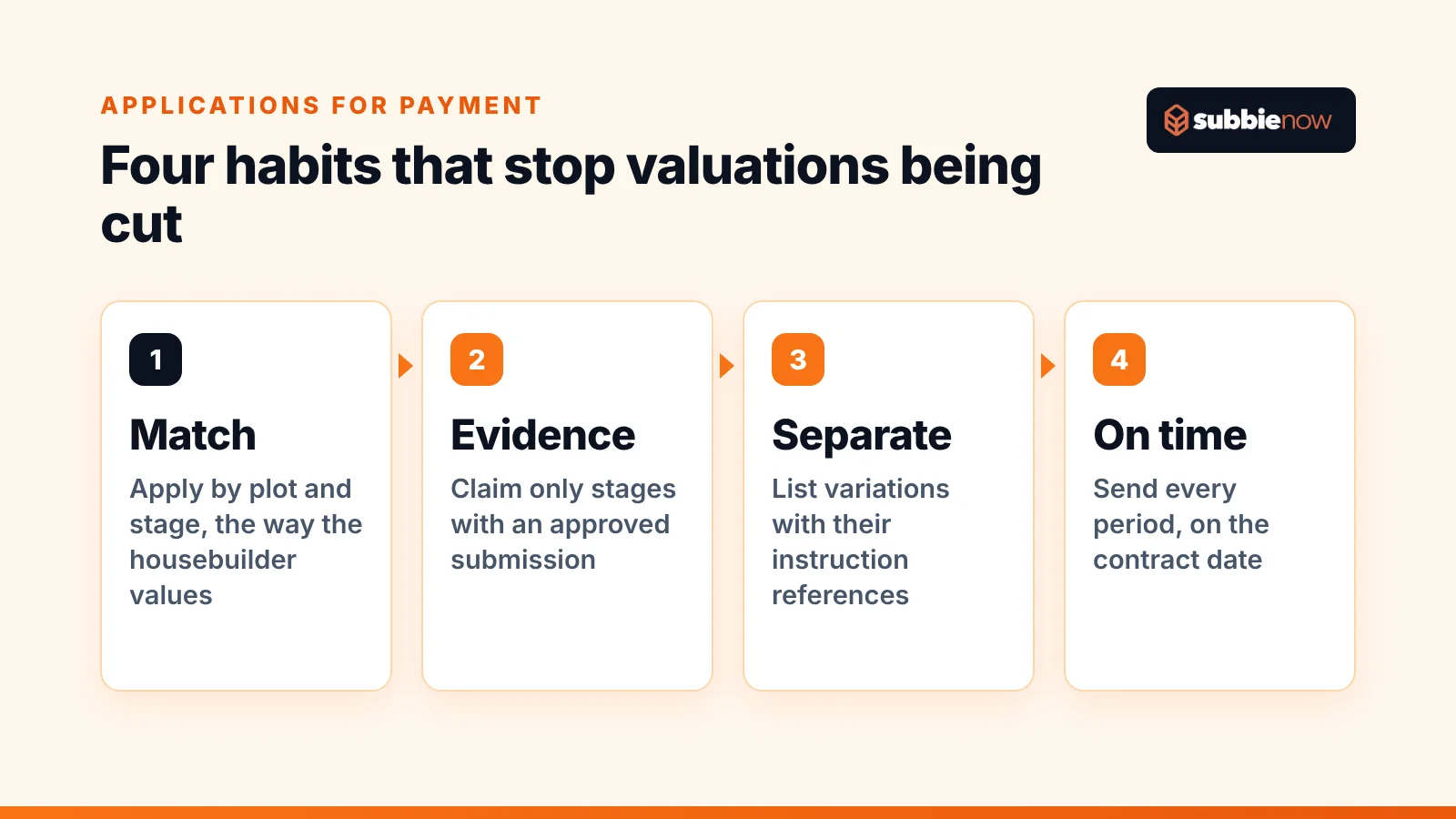
Valuations get cut when the QS can't see why a line is due. Three habits make the biggest difference.
1. Match the contractor's breakdown exactly. If the housebuilder values by plot and stage, apply by plot and stage. A lump sum per house type forces the QS to do their own breakdown, and they'll be cautious.
2. Claim only what's evidenced. Every stage you claim should have a submission behind it from the operative who did the work. If a stage is 80% done, say so rather than claiming it complete and arguing later.
3. Keep variations separate and referenced. Unreferenced extras are the first thing removed. Record variations on site when they happen, with a photo and who instructed them.
A worked example
Fictional example. Ashby Heating, a 14-person plumbing and heating subcontractor, is on a 60-plot site. Their application for June:
| Line | Value to date |
|---|---|
| First fix: plots 1 to 24 complete | £38,400 |
| Second fix: plots 1 to 12 complete | £21,600 |
| Variation V07: relocated boiler flues, plots 9 to 12 | £1,180 |
| Sales extras: 6 × additional towel rails | £540 |
| Gross value to date | £61,720 |
| Less retention at 3% | −£1,852 |
| Less previous payments | −£44,300 |
| Due this application | £15,568 |
Because each line traces back to approved submissions on specific plots, the QS can check it in minutes. The variation has an instruction reference, so it goes through instead of being parked for "discussion at the next meeting".
How subcontractor software helps
Building an application by hand means pulling together timesheets, WhatsApp photos and spreadsheets from several people. In SubbieNow, operatives raise work submissions against the plot and stage from the iOS app, the office approves them, and Sales Applications are built from build stages, sales extras, variations and contra charges, then exported as a document set for the housebuilder.
The result is an application that is the same shape every month, on time, with the evidence attached.
Checklist before you send
- Period end date and application number are correct
- Every claimed stage has an approved submission behind it
- Variations have references and are listed separately
- Sales extras installed this period are included
- Contra charges are listed, and any you dispute are flagged
- Retention and previous payments are deducted correctly
- Certificates needed for stage payment are attached
If your applications are rebuilt from scratch every month, book a 30-minute demo and we'll show you how they come together in SubbieNow on your own plots. Pricing is on the pricing page.
Frequently asked questions
When should a subcontractor send an application for payment?
On the dates your subcontract sets out, usually monthly. If the contract is silent, the Scheme for Construction Contracts fills the gap, but most housebuilder subcontracts set a fixed application date. Missing it can push your payment back a full cycle.
Should I include variations that haven't been agreed yet?
Include them as a separate, clearly labelled section with the instruction reference and your price. That keeps them visible without mixing them into the agreed contract value.
What evidence should go with an application?
Plot-by-plot progress, signed-off work submissions, photos where work is hidden later, variation instructions and any certificates the contractor needs before paying a stage.