The Construction Act (the Housing Grants, Construction and Regeneration Act 1996, as amended in 2011) gives subcontractors real protection on payment, but only if you know the dates. This is a plain-English guide to the payment cycle. It isn't legal advice: your subcontract may set different periods, and you should take advice on a dispute.
What are the key dates?
| Step | Who | When (default if the contract is silent) |
|---|---|---|
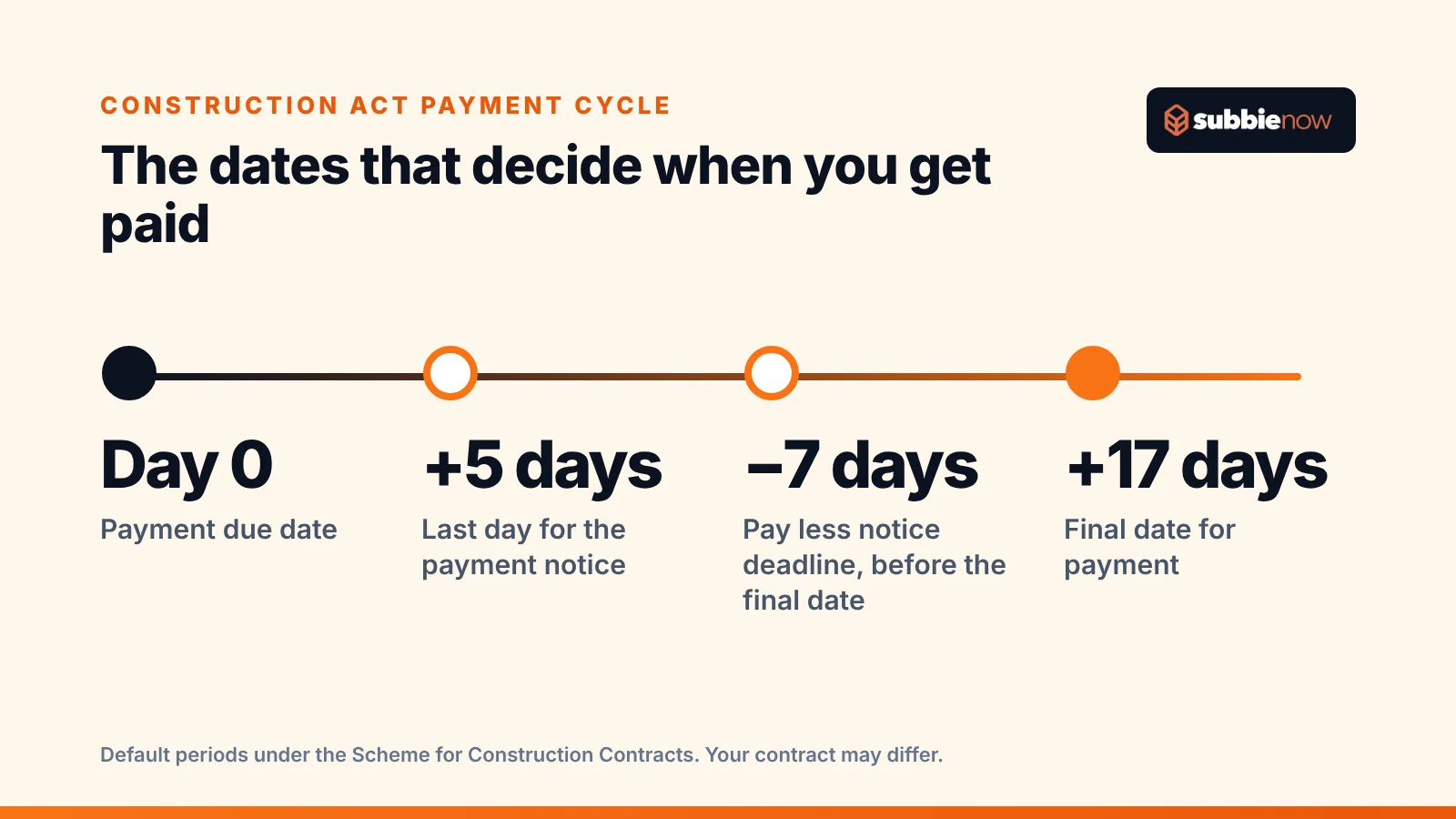
| Due date | Set by the contract | Under the Scheme for Construction Contracts: 7 days after the later of the end of the period or the making of a claim |
| Payment notice | Payer (or a specified person) | No later than 5 days after the due date, even if the sum is zero |
| Default payment notice | Payee | If no payment notice is given in time |
| Pay less notice | Payer | No later than the prescribed period before the final date for payment: 7 days under the Scheme |
| Final date for payment | Set by the contract | Under the Scheme: 17 days after the due date |
The payment notice deadline of 5 days after the due date is fixed by the Act. Many of the other periods can be set by the contract, which is why you need to read yours.
What is a payment notice?
A payment notice states the sum the payer considers due at the due date and how it was calculated. It must be given even if the amount is zero. Its job is to make it clear, early, what you'll be paid and why.
What is a pay less notice?
A pay less notice is required if the payer intends to pay less than the notified sum, for example because of a contra charge or a disputed variation. It must set out the sum the payer considers due and the basis of the calculation, and it must be given in time. If there is no valid pay less notice, the notified sum must be paid by the final date for payment.
A worked timeline
Fictional example, using the Scheme's default periods:
| Date | Event |
|---|---|
| 31 August | Period end; application submitted the same day |
| 7 September | Due date (7 days later) |
| 12 September | Last day for the payment notice (5 days after the due date) |
| 17 September | Last day for a pay less notice (7 days before the final date) |
| 24 September | Final date for payment (17 days after the due date) |
If, on 20 September, the subcontractor hears that £2,000 is being held back for "snagging" with no pay less notice sent, that deduction is open to challenge.
What can you do if you aren't paid?
If the notified sum isn't paid by the final date, the Act gives a right to suspend performance after giving at least 7 days' notice, and disputes can be referred to adjudication. Both are serious steps: get advice first.
How good records help
Most payment rows are about evidence, not law. If your application is built from approved work submissions, referenced variations and listed contra charges, there is less for a payer to dispute and it's easier to show when a deduction has no proper notice. SubbieNow keeps those records on each plot and builds sales applications from them.
Sources
- The Scheme for Construction Contracts (England and Wales) Regulations 1998, Part II
- Housing Grants, Construction and Regeneration Act 1996, Part II
Want applications that leave less to argue about? Book a 30-minute demo.
Frequently asked questions
What happens if the contractor doesn't send a payment notice?
The payee can issue its own default payment notice (or its application may stand as one, depending on the contract), and the sum in it becomes payable unless a valid pay less notice is given in time.
Does the Construction Act apply to my subcontract?
It applies to most construction contracts in England, Wales and Scotland, including most subcontracts on housing sites. There are exceptions, for example contracts with residential occupiers for work on their own home. Check with an adviser if unsure.
Can a pay less notice be issued after the final date for payment?
No. It must be given no later than the prescribed period before the final date for payment. A late pay less notice is not valid.