
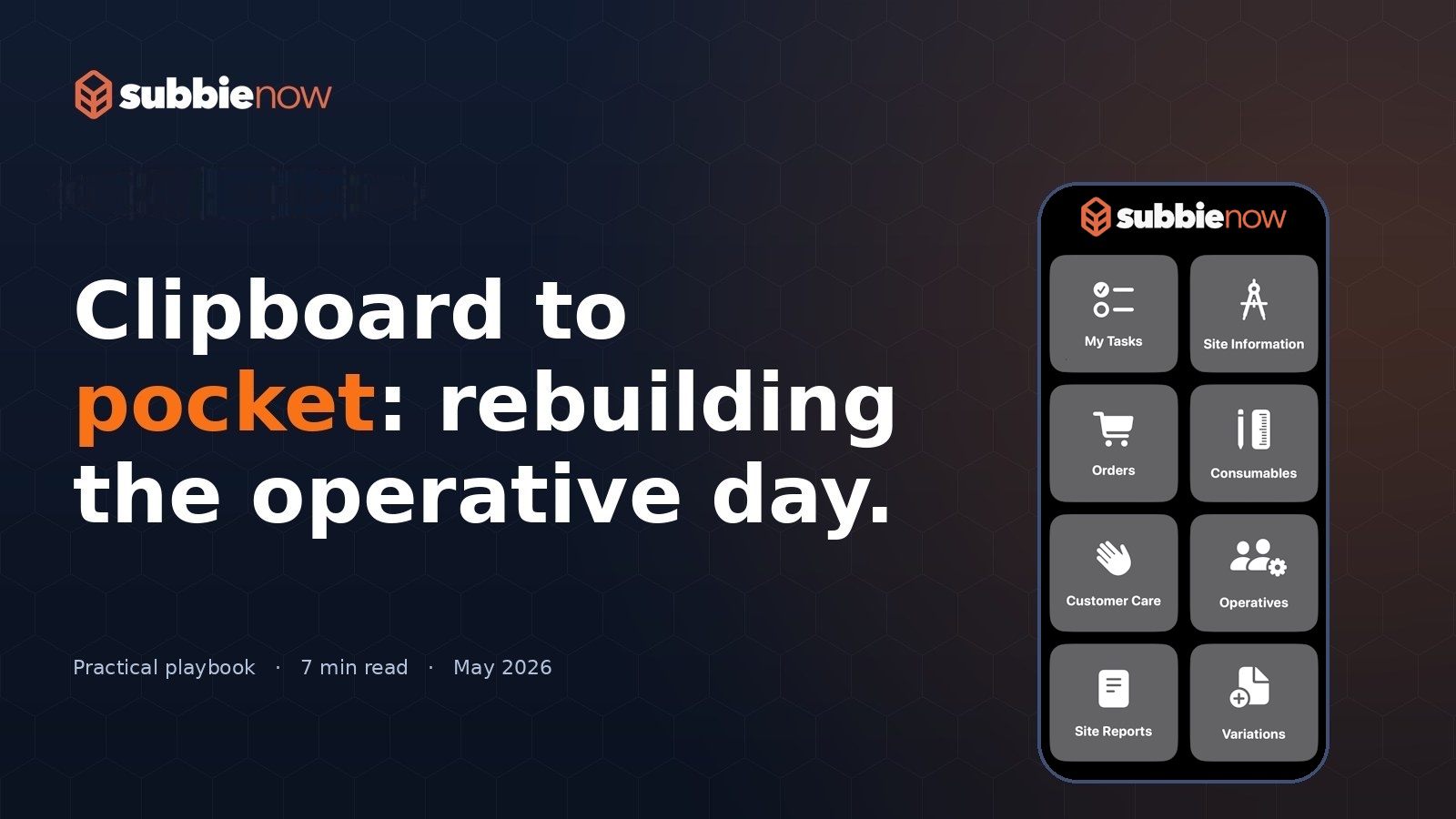
For two decades, subcontractor field work has run on a clipboard. Pre-printed sheets, a biro, a phone in a pocket for the photos that never get sent, and an end-of-week reconciliation that takes longer than the job itself. We’ve all seen the file box of timesheets. We’ve all chased a missing day’s work because a sheet got rained on.
The temptation, when teams move to digital, is to rebuild the clipboard on a phone. Forms that mirror the paper. A submit button at the bottom. Done.
That approach is why so many mobile rollouts stall. Operatives don’t want a paper form on a small screen — they want fewer steps. This article is about the small choices that decide whether your app gets used, drawn from watching hundreds of subcontractor teams adopt mobile tooling.
The three failure modes
Mobile rollouts fail in remarkably consistent ways. Almost every stalled project we’ve reviewed fell into one or more of these three buckets.
Failure mode 1: too much, too fast. The office IT team rolls out everything at once — tasks, submissions, orders, consumables, variations, customer care, forms, site reports. Operatives faced with eleven new things to learn revert to the clipboard. The platform sits at 12% adoption six months in.
Failure mode 2: no plot context. The app asks for a job number, a record code, a quantity. The operative is on a third-floor flat, in the rain, with cold fingers. They put the wrong code in. The office spends Monday morning correcting twenty submissions. Trust collapses.
Failure mode 3: nothing visible changes. The operative submits work. The office processes it on Friday. The operative finds out on payday whether it was approved. There is no signal in the field that the system is doing anything, so the system is not real.
The shape of an operative day that works
The operatives we’ve watched succeed with SubbieNow follow a remarkably consistent pattern. It’s worth describing in plain terms.
On arrival. They open the app, see the tasks allocated to them for that day, and tap into the first one. The task carries plot context — drawings, materials list, specifications — so there’s no walk back to the van for a paper sheet.
During the work. If they need materials, they raise an order from the app against the plot. If they spot a variation, they photograph it and submit it as a variation against the plot. If the customer asks for something off-spec, they capture it as a customer care record at the same point. Everything attaches to the plot automatically.
At completion. They mark the task complete and the work submission opens with plot, record and quantity pre-filled from the task itself. The operative confirms the quantity, hits submit, and the system rolls the value live into the office’s application total.
Visible feedback. Within minutes, the operative sees the submitted value in their own running totals (approved, pending, rejected, submitted). They never wonder whether the office got it.
The single biggest predictor of adoption is whether the operative can see the consequence of their action on their own screen, in real time. Approved totals visible to the operative themselves are the closest thing to a magic adoption lever we’ve found.
Choosing what to switch on first
If you take only one operational insight from this article, take this: start with tasks and work submissions. Nothing else. Get the loop of “task issued → task completed → submission raised → totals updated” working for every operative, every day, for two weeks.
Then layer in orders, because the savings show up on the next purchasing cycle and operatives feel them. Then variations, because the QS feels it. Then site reports, because the contracts manager feels it. Then customer care, because aftercare margin recovers. Then forms, because compliance gets cheaper.
That’s six rollouts, not one. Each one takes a week. By month two, every operative is in the app every day, the office has stopped processing paper, and the contracts manager is seeing the site from a dashboard instead of a phone call.
What you stop doing
The hardest part isn’t the adoption — it’s the discontinuation. Mobile-first only works if the paper alternatives are taken away. Half the failed rollouts we’ve seen are rollouts where the old paper sheets were still being accepted “as a fallback”. Operatives revert; the office processes both; nobody benefits.
Pick a date. Stop accepting paper. The discomfort lasts about four days.