
Author: The SubbieNow Team

  • Clipboard to pocket: rebuilding the operative day.

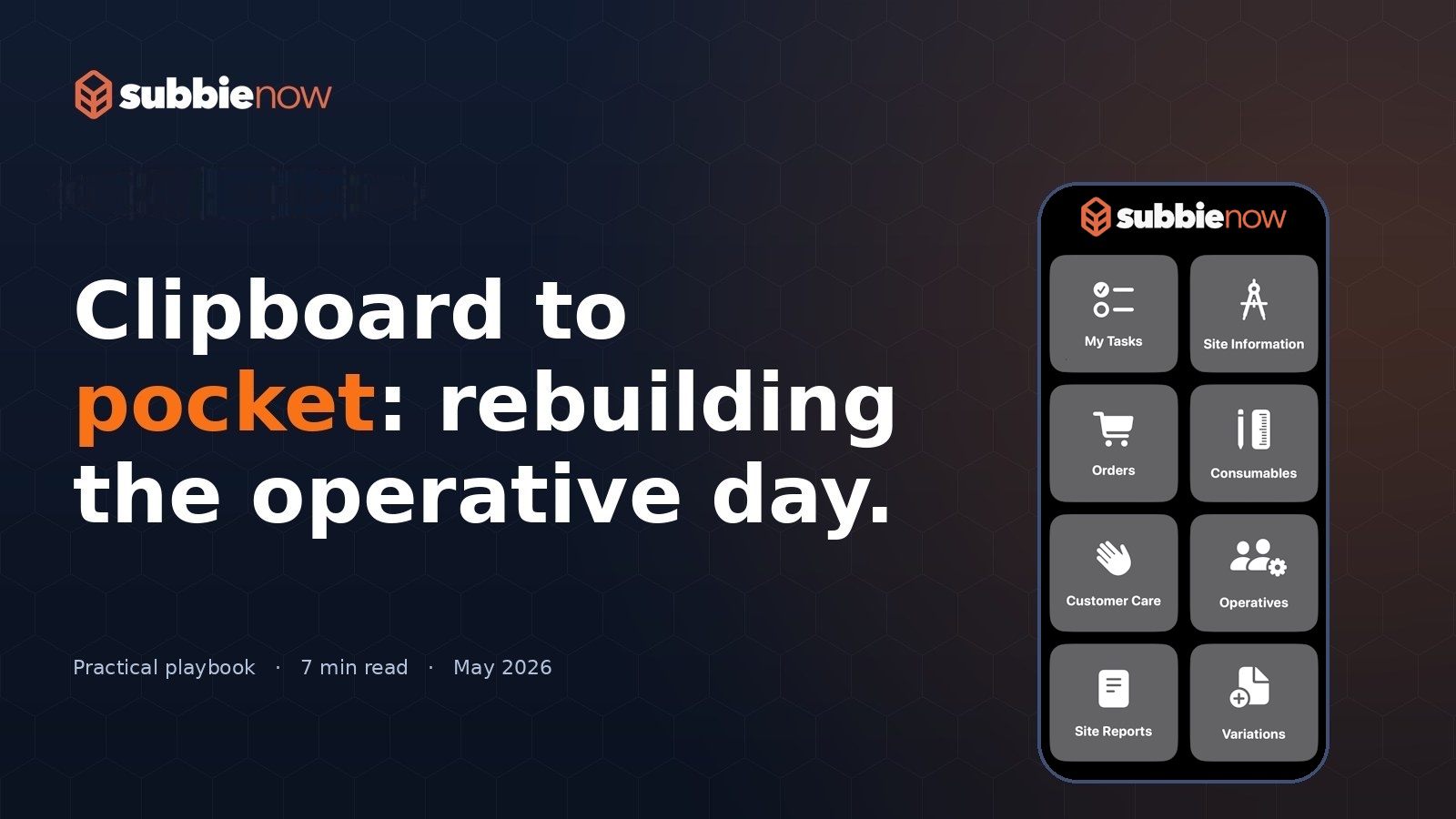
    Clipboard to pocket: rebuilding the operative day.

    For two decades, subcontractor field work has run on a clipboard. Pre-printed sheets, a biro, a phone in a pocket for the photos that never get sent, and an end-of-week reconciliation that takes longer than the job itself. We’ve all seen the file box of timesheets. We’ve all chased a missing day’s work because a sheet got rained on.

    The temptation, when teams move to digital, is to rebuild the clipboard on a phone. Forms that mirror the paper. A submit button at the bottom. Done.

    That approach is why so many mobile rollouts stall. Operatives don’t want a paper form on a small screen — they want fewer steps. This article is about the small choices that decide whether your app gets used, drawn from watching hundreds of subcontractor teams adopt mobile tooling.

    The three failure modes

    Mobile rollouts fail in remarkably consistent ways. Almost every stalled project we’ve reviewed fell into one or more of these three buckets.

    Failure mode 1: too much, too fast. The office IT team rolls out everything at once — tasks, submissions, orders, consumables, variations, customer care, forms, site reports. Operatives faced with eleven new things to learn revert to the clipboard. The platform sits at 12% adoption six months in.

    Failure mode 2: no plot context. The app asks for a job number, a record code, a quantity. The operative is on a third-floor flat, in the rain, with cold fingers. They put the wrong code in. The office spends Monday morning correcting twenty submissions. Trust collapses.

    Failure mode 3: nothing visible changes. The operative submits work. The office processes it on Friday. The operative finds out on payday whether it was approved. There is no signal in the field that the system is doing anything, so the system is not real.

    The shape of an operative day that works

    The operatives we’ve watched succeed with SubbieNow follow a remarkably consistent pattern. It’s worth describing in plain terms.

    On arrival. They open the app, see the tasks allocated to them for that day, and tap into the first one. The task carries plot context — drawings, materials list, specifications — so there’s no walk back to the van for a paper sheet.

    During the work. If they need materials, they raise an order from the app against the plot. If they spot a variation, they photograph it and submit it as a variation against the plot. If the customer asks for something off-spec, they capture it as a customer care record at the same point. Everything attaches to the plot automatically.

    At completion. They mark the task complete and the work submission opens with plot, record and quantity pre-filled from the task itself. The operative confirms the quantity, hits submit, and the system rolls the value live into the office’s application total.

    Visible feedback. Within minutes, the operative sees the submitted value in their own running totals (approved, pending, rejected, submitted). They never wonder whether the office got it.

    The single biggest predictor of adoption is whether the operative can see the consequence of their action on their own screen, in real time. Approved totals visible to the operative themselves are the closest thing to a magic adoption lever we’ve found.

    Choosing what to switch on first

    If you take only one operational insight from this article, take this: start with tasks and work submissions. Nothing else. Get the loop of “task issued → task completed → submission raised → totals updated” working for every operative, every day, for two weeks.

    Then layer in orders, because the savings show up on the next purchasing cycle and operatives feel them. Then variations, because the QS feels it. Then site reports, because the contracts manager feels it. Then customer care, because aftercare margin recovers. Then forms, because compliance gets cheaper.

    That’s six rollouts, not one. Each one takes a week. By month two, every operative is in the app every day, the office has stopped processing paper, and the contracts manager is seeing the site from a dashboard instead of a phone call.

    What you stop doing

    The hardest part isn’t the adoption — it’s the discontinuation. Mobile-first only works if the paper alternatives are taken away. Half the failed rollouts we’ve seen are rollouts where the old paper sheets were still being accepted “as a fallback”. Operatives revert; the office processes both; nobody benefits.

    Pick a date. Stop accepting paper. The discomfort lasts about four days.

  • How subbies shrink the quote-to-cash gap.

    How subbies shrink the quote-to-cash gap.

    Almost every subcontractor we talk to has a margin leak in the same place: the gap between work done and money received. It rarely shows up as a single bad month. Instead, it shows up as a creeping drift — applications drafted late, valuations contested in long email chains, retentions forgotten, certified work re-applied for next month because nobody can find the original. By the time the bank-feed says it, the damage is six weeks old.

    This article is a practical playbook for closing that gap. It’s drawn from twenty months of working alongside UK subbies and watching what the high-performers do differently. None of it requires hiring; most of it requires re-sequencing.

    1. Stop treating applications as paperwork

    The number-one shift among subcontractors who get paid quickly is that they treat the application as the deliverable — not a by-product of the deliverable. If you measure operatives on “work done”, you’ll get work done. If you measure them on “work submitted and approved”, you’ll get cashflow.

    The most useful operational change is removing the gap between completion and submission. In SubbieNow that means operatives raise the work submission on the same screen they marked complete, and totals roll up live into the office portal so the QS sees what’s chargeable before week-end. The team that previously cut-off submissions at 4pm Friday now sees applications worth £40k–£90k clear the office by Thursday lunchtime.

    Rule of thumb: if your office is doing data entry on Friday afternoon to pull together Monday’s application, your application cycle is structurally too slow. Submissions should land on the application as they happen, not at week-end.

    2. Make the rejection reason a feature, not a fight

    Applications get held up by disputes, but most disputes are not big-ticket arguments — they’re small queries that get bundled, then escalated, because nobody remembers what was originally rejected. Capturing the rejection reason at the point of rejection, against the line item, with photo evidence attached, turns “we’ll resolve it in the meeting” into “we’ll resolve it in two clicks”. One SubbieNow user calls this their “queue-of-one”: every rejection becomes a single re-submittable record with everything needed to clear it.

    3. Charge for variations the moment they happen

    The single biggest source of margin erosion we see is unrecorded variations. Some are forgotten entirely; some are mentioned in WhatsApp and never reach the QS; some are agreed verbally and never confirmed. By the time the application goes in, the price has been built around the original drawings and the £20k of extras has evaporated.

    The fix is process more than tooling, but tooling helps. A variation register that any contracts manager or operative can write to from site — with image, location, time, requested-by — converts an evening’s reconstruction into a five-second record. Combined with a rule that no variation gets started until logged, this single change typically lifts margin by 3–6%.

    4. Send the client the same view you’re looking at

    Application disputes are usually really information-asymmetry disputes. The client’s QS sees a number with no audit trail; the subcontractor sees a number with full backing data. The only way to close the gap is to give the client a view of the underlying records — by plot, by record, by date. The high-performers we work with literally screen-share the live application portal during valuation calls. It changes the conversation from “I think this is wrong” to “show me line 47”.

    5. Treat retentions like a calendar, not a liability

    The other quiet margin killer is retentions. They are owed, but they’re invisible because they sit in a “later” bucket. Most subbies discover their retention release dates by accident, months after the trigger event. The fix is to log retention release dates against the application that produced them and put them on the calendar. SubbieNow customers chasing retentions this way collect, on average, 24% more retention value than those tracking them in spreadsheets — purely because they ask earlier.

    What “good” looks like

    Across our customer base, the median subcontractor reduced average days-to-payment from 34 days to 19 days in the first six months of running their applications through SubbieNow. That’s not because the platform is magic — it’s because the platform forces the underlying behaviours: submit at point of completion, dispute at point of rejection, log the variation as it happens, surface the retention before it’s overdue.

    The investment isn’t software, it’s discipline. The software just makes the discipline cheaper to maintain.